What should a wedding planner's homepage say?
In the first two lines: what you do, where you do it and who it's for, followed by one clear way to inquire. Then your services with a starting price, proof from real couples, how working with you goes, a short introduction to you, the questions couples always ask, and an inquiry form. That order answers what a couple needs to know before they contact you, and it gives Google and AI assistants plain facts to read.
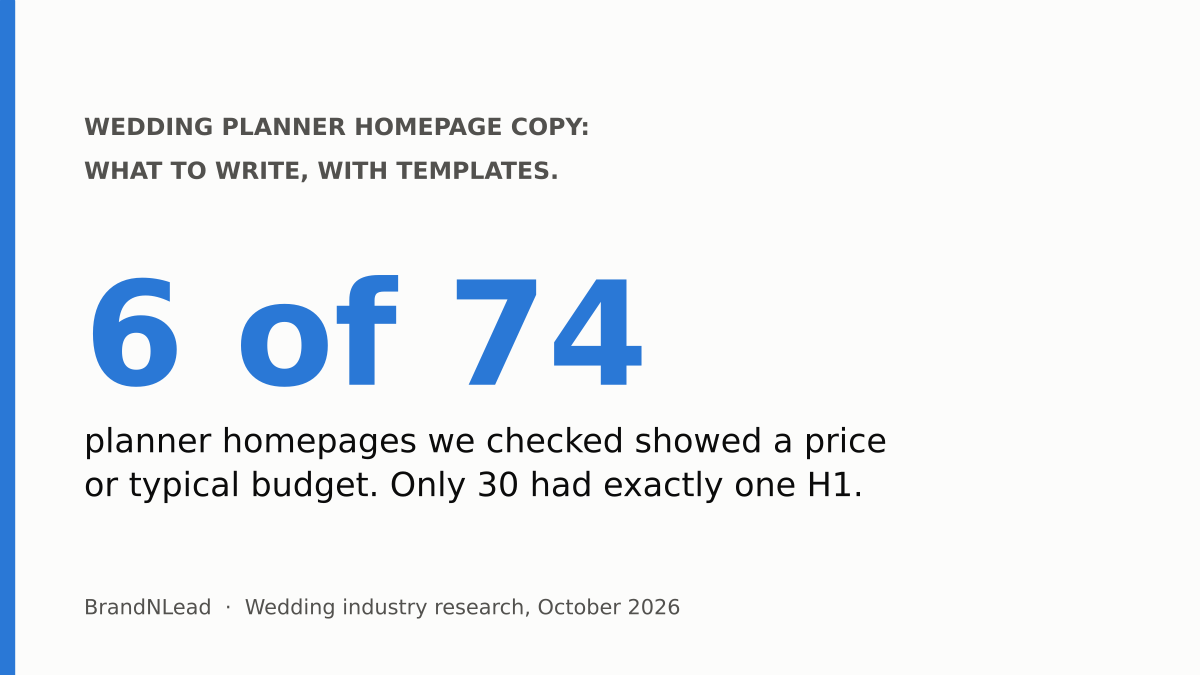
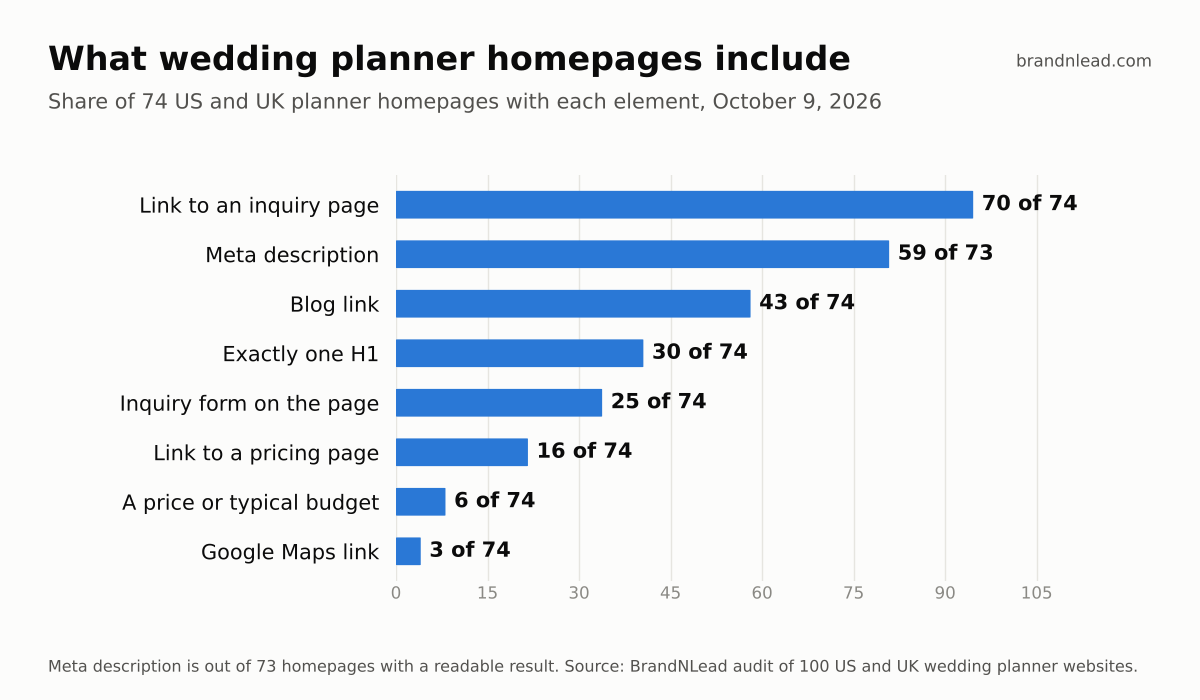
Most planner homepages skip at least half of it. In our audit of 74 US and UK planner homepages, only 30 had exactly one main heading, 25 had an inquiry form on the page, and 6 showed any price. Below are the sections, what to write in each, and fill-in-the-blank templates.
What order should the homepage sections go in?
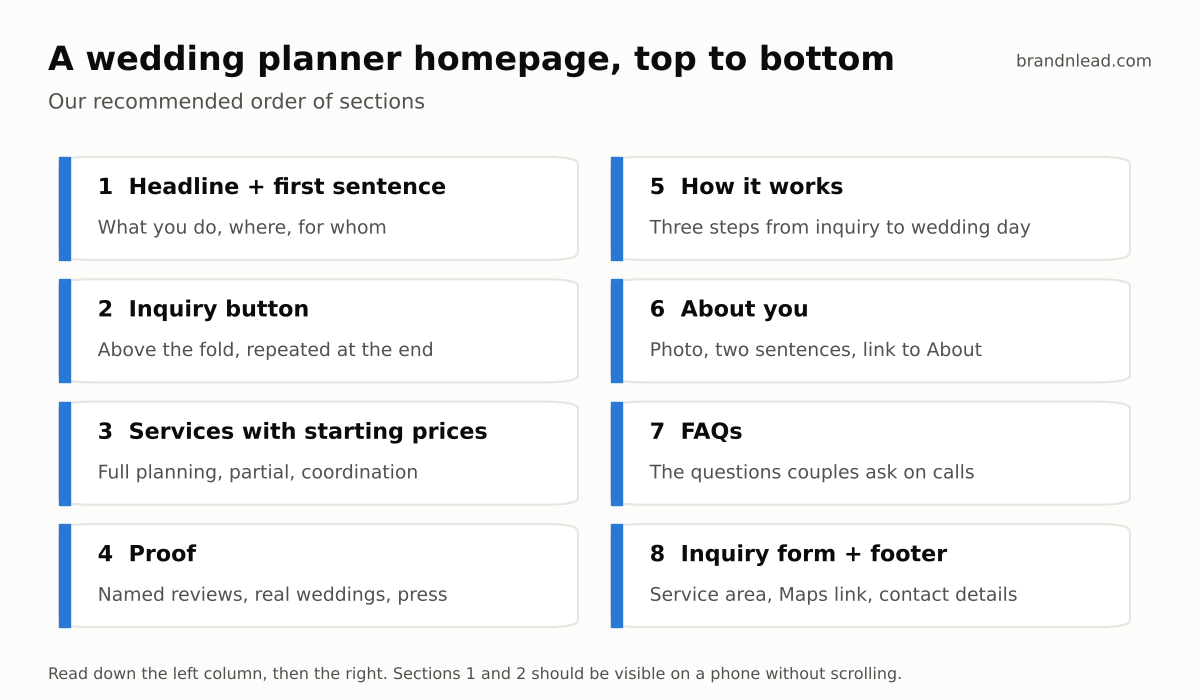
This is our recommended structure, not a measured result. It follows the order of a couple's questions: is this the right kind of planner, in my area, in my budget, can I trust them, how does it work, who are they, and how do I get in touch.
1. What should the headline and first sentence say?
Say what you do and where, in plain words. A tagline like "Love, beautifully planned" can sit underneath, but it shouldn't be your main heading (the H1 tag), because it tells neither couples nor search engines what you offer. 17 of the 74 homepages we checked had no H1 at all and 27 had several. Google says there's no ideal number of headings (SEO Starter Guide), so one clear H1 is about clarity, not a ranking rule.
Template:
- Headline (H1): "[City or region] wedding planner for [type of wedding or couple]". For example: "Charleston wedding planner for modern, guest-first weddings".
- First sentence: "[Business name] is a wedding planning studio in [city] offering full planning, partial planning and wedding-day coordination for [who you serve], across [region] and [destinations, if any]."
That first sentence matters beyond Google. In our test of 40 AI answers, 31 linked planners' own websites, so a plain, factual opening line is the kind of text these tools can quote.
2. Where should the inquiry button go?
Directly under the headline, and again at the bottom of the page. 70 of 74 homepages linked to an inquiry page somewhere, but only 25 had a form on the homepage itself. Template: a button that says "Check your date" or "Start your inquiry", not just "Contact". We cover what the form should ask in how to get more inquiries.
3. How do you describe your services?
One short block per service, each with who it's for and a starting price. Only 6 of 74 homepages showed a price or typical budget, so even a starting point sets you apart.
- Full planning: "For couples who want us with them from the first venue tour to the last dance. Most full-planning couples invest $[X] to $[Y]."
- Partial planning: "For couples who've started and want an expert to take it from here. From $[X]."
- Wedding-day coordination: "For couples who've planned it themselves and want the day run for them. From $[X]."
4. What proof should a planner homepage show?
Real, named proof beats adjectives. Use two or three short reviews with the couple's first names and venue (with their permission), photos from weddings you actually planned with the photographer credited, and any publications that featured your work. Never write reviews yourself or use stock photos as if they were your weddings.
5. How should you explain how it works?
Three steps, one line each. Template: "1. Tell us about your wedding: send your date, guest count and venue (if you have one). 2. Meet us: a 30-minute call to see if we're the right fit. 3. Start planning: we send a proposal within [X] days." Use your real process and timings.
6. What should the About section say?
A photo of you, two sentences and a link to your full About page. Template: "I'm [name], and I've planned [real number] weddings across [region] since [year]. I started [business name] because [one honest reason]." If you don't track the number, leave it out rather than guess.
7. Which FAQs belong on the homepage?
The four to six questions couples ask on almost every call: where you work, whether you travel, how far ahead to book, what your starting price is, and what's included. Short, direct answers. These also give Google and AI assistants clear question-and-answer text to work with.
8. What goes in the footer?
Your inquiry form or a final button, your service area in words ("Serving Charleston, Kiawah and the Lowcountry"), contact details, and a link to your Google Maps listing. Only 3 of 74 homepages linked to theirs; our Google Business Profile guide covers setting one up.
What should the page title and meta description say?
The page title is the blue link people see in Google. Google's guidance is to write a title that's descriptive and concise, avoid keyword stuffing and keep your brand short (Google Search Central). The meta description is the summary that may show under it; 14 of 73 homepages we checked had none.
- Title template: "Wedding Planner in [City], [State or County] | [Business name]"
- Meta description template: "[Business name] plans [type of] weddings in [city] and [region]. Full planning, partial planning and coordination from $[X]. Check your date today."
What does this look like on a real homepage?
We rewrote our own homepage on October 13, 2026 with the same rules. Our main heading now says "Wedding marketing agency · Branding, websites & SEO", our first sentence is "BrandNLead is a wedding marketing agency.", the page title starts with "Wedding Marketing Agency", and our homepage FAQs are marked up so search engines can read them. It's too early to report results; we'll share them once we have a few months of Search Console data.
For the other problems we found on planner sites, see 10 wedding website mistakes. If you'd rather we write and build it, see our website design for wedding planners.
How did we collect this data?
- Sample: 100 US (70) and UK (30) wedding planner websites found through Google searches. 74 homepages were live and checkable on October 9, 2026.
- Checks: each homepage's code was checked for H1 tags, meta description, inquiry link and form, pricing, blog link and Google Maps link.
- Limits: homepages only and a small sample. We didn't measure rankings or inquiries, and the section order above is our recommendation, not a tested result. Individual sites are not named.