How do you get recommended by ChatGPT as a wedding planner?
Make your own website say plainly who you are, what you do and where, let ChatGPT's search crawler read it, and get listed on the wedding directories and "best planners in [city]" roundups that AI tools pull from. In our October 2026 test, ChatGPT and Gemini cited planners' own websites in 31 of the 34 answers that showed sources, and wedding directories or roundup lists in 26 of them.
We ran the test on October 15, 2026. We asked two questions couples actually ask, in 10 US and UK cities, on both ChatGPT and Gemini, signed out, in a fresh chat every time. That gave us 40 answers. Here is what came back, and what it means for your business.
Does ChatGPT recommend wedding planners?
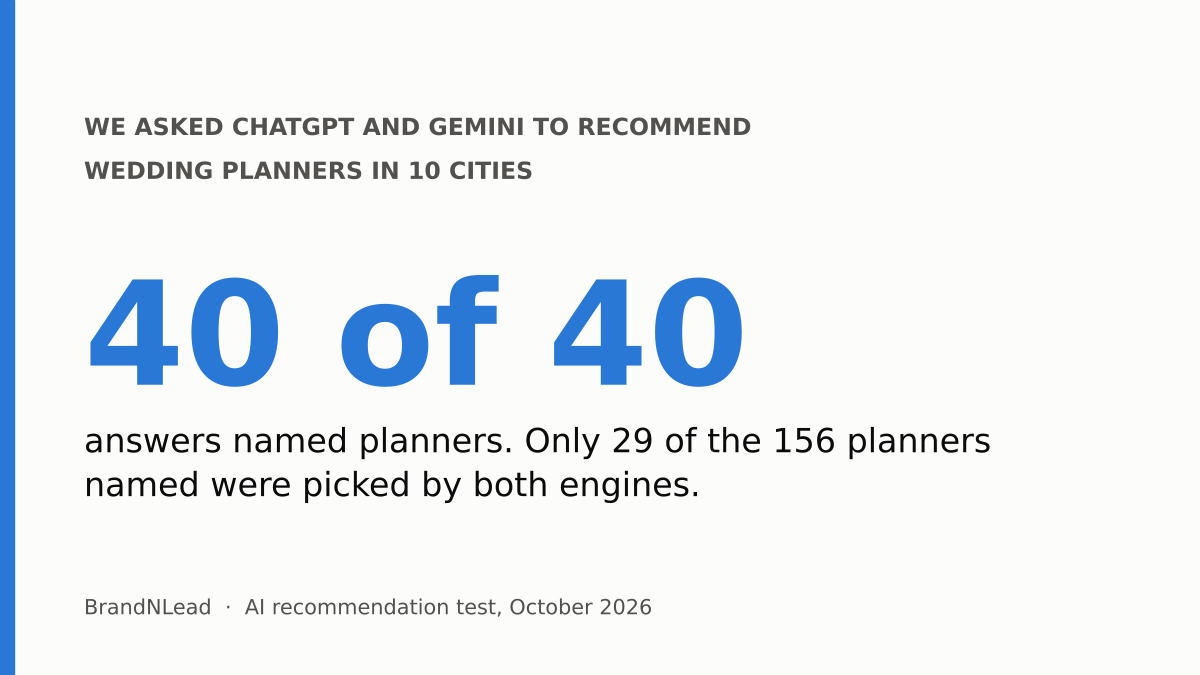
Yes, every time we asked. All 40 answers named specific planners. ChatGPT named 5.6 planners per answer on average and Gemini named 6.9. Across the 10 cities, the two tools named 156 different planning businesses.
Couples are already asking these questions inside ChatGPT. On February 3, 2026, The Knot launched an app inside ChatGPT that recommends vendors across 24 categories, drawing on nearly 200,000 US vendors listed on The Knot (The Knot Worldwide announcement).
Where does ChatGPT get its wedding planner recommendations?
From two kinds of sources: planners' own websites, and wedding directories or "best of" lists. Most answers used both.
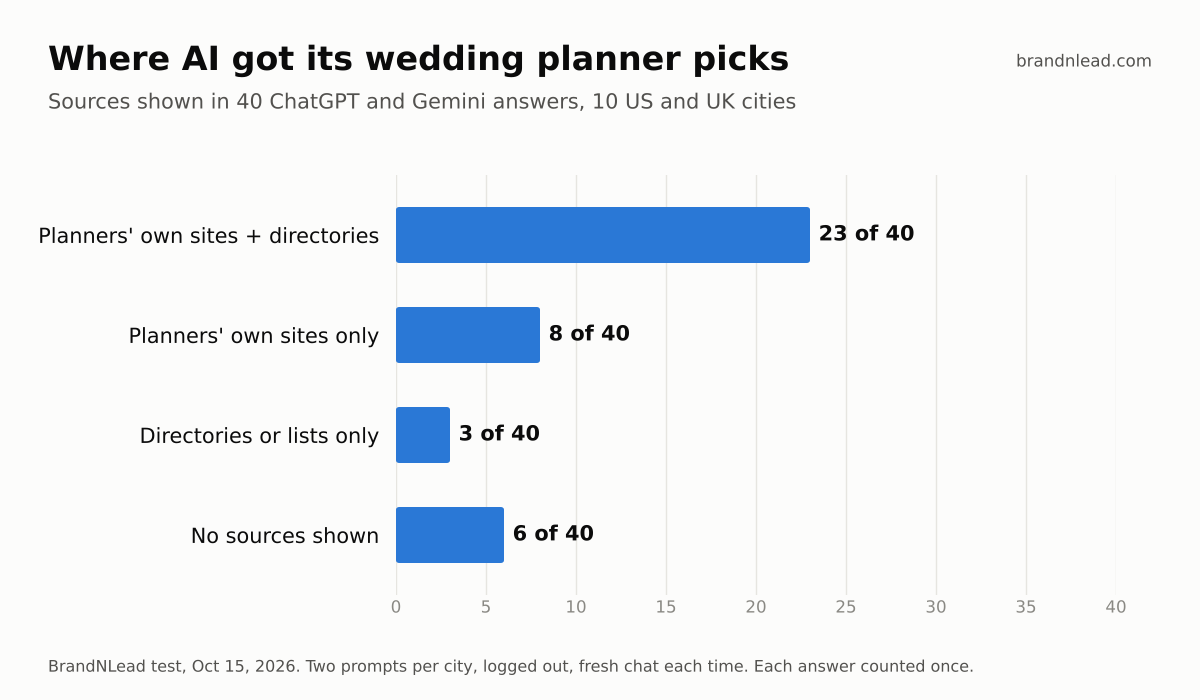
The two tools behaved differently. ChatGPT linked to planners' own websites in all 17 of its answers that showed sources, and to a directory in 9. Gemini cited a directory or list in all 17 of its answers with sources, and planners' own sites in 14. In 2 of Gemini's 20 answers it skipped citations and showed planners pinned on Google Maps instead.
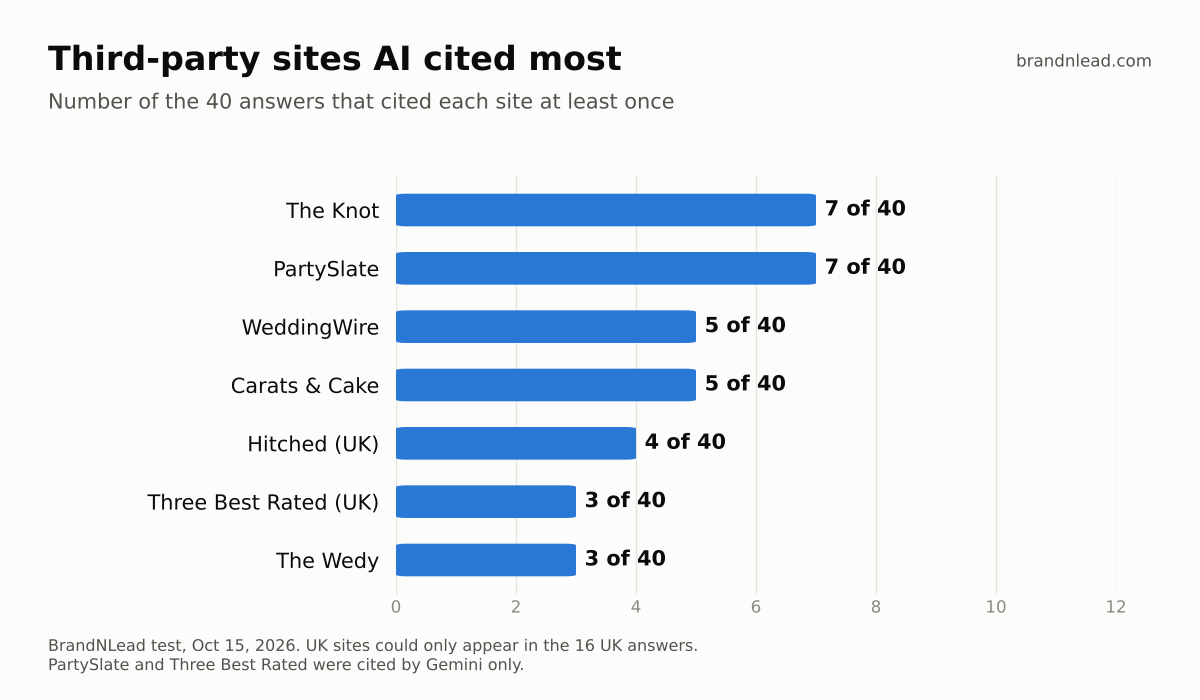
No single directory dominated. The most-cited, The Knot and PartySlate, each appeared in 7 of the 40 answers. In the UK, Hitched and Three Best Rated came up most. Several answers also leaned on one-off "best wedding planners in [city]" roundups published by wedding blogs, photographers and event-space sites.
Will ChatGPT recommend the same planners every time?
No. Of the 156 planners named, only 29 were named by both ChatGPT and Gemini. Even the same tool changed its list when we reworded the question: ChatGPT kept about a third of its planners between our two questions, and Gemini a little over a third.
So there is no single "AI ranking" to win. A few planners did show up again and again, though: Scarlett & Bell appeared in all 4 Edinburgh answers, and Brilliant Event Planning in 3 of the 4 New York answers. Being findable in many places is what gives you more of those chances.
What should a wedding planner do to get recommended by ChatGPT?
Six steps, from quickest to slowest. The first two take an afternoon. Step 1 comes from OpenAI's own documentation; the rest are our recommendations, based on what the tools cited in our test.
- Let ChatGPT's search crawler read your site. Open yourdomain.com/robots.txt (the file that tells crawlers what they may read). If you see "User-agent: OAI-SearchBot" followed by "Disallow: /", remove it, or switch off any "block AI crawlers" setting in your website builder. OpenAI says sites that block OAI-SearchBot won't appear in ChatGPT's search answers (OpenAI's crawler documentation). Blocking GPTBot, which collects data for training OpenAI's models, is a separate choice and doesn't remove you from search.
- Say who, what and where in plain text on your homepage. Your main heading and first sentence should read something like "[Name] is a full-service wedding planner in [city]." Write it as real text, not text inside an image. When we audited 74 wedding planner homepages, 17 had no main heading (the H1 tag that tells search engines and AI tools what a page is about) at all.
- Give each service and area its own page. Full planning, partial planning, day-of coordination, and the cities or venues you work in, each on a page with its own heading. Add a starting price if you can: only 6 of the 74 homepages we audited showed one.
- Claim and complete your directory profiles. In the US, that means The Knot, WeddingWire, PartySlate and Carats & Cake. In the UK, Hitched and Three Best Rated were cited most. Search "[your city] wedding planner" on each one and check that you're listed with current details, photos and reviews. Paid upgrades are your call: we have no data showing that paying changes what AI tools say.
- Get into "best wedding planners in [city]" roundups. Find the lists AI cites for your city by running the test below, then pitch whoever wrote them: a local wedding blog, a photographer, a venue. Skip any list that sells spots without labeling them as paid; buying links that aren't marked as sponsored breaks Google's spam policies.
- Complete your Google Business Profile, then test every month. Gemini's map-based answers come from Google Maps listings. Once a month, ask the two questions below and write down who is named and which sites are cited.
Which questions should you test?
Use the exact wording we used so your results compare month to month:
- "Who are the best wedding planners in [your city]?"
- "I'm getting married in [your city] and need a full-service wedding planner. Who would you recommend?"
Use a signed-out or private window, start a fresh chat for each question, don't ask follow-ups, and note which sites each answer cites. If you'd rather we ran it for you, request a free AI Visibility Snapshot.
How did we run this test?
- Date: October 15, 2026.
- Tools: ChatGPT and Gemini, signed out, a fresh chat for every answer, no follow-up questions. Perplexity required a login on the first run, so it isn't included.
- Cities: New York, Los Angeles, Chicago, Charleston, Austin and Miami in the US; London, Edinburgh, Bath and Bristol in the UK.
- Questions: the two above, word for word. 10 cities × 2 questions × 2 tools = 40 answers.
- Counting: a site counts once per answer, however many times that answer cited it. Planners were matched by business name.
- Limits: one day and 40 answers. AI answers change by day, location and account, so treat this as a snapshot, not a ranking of planners. Neither company publishes how it weighs sources; the steps above follow from what the tools cited, not from inside knowledge.
This is part of our research on how wedding businesses get found online. Read next: we audited 100 wedding planner websites, AI search optimization for wedding planners and SEO for wedding planners.