How is SEO different for a luxury wedding planner?
A luxury planner needs fewer inquiries than a mid-market planner, but each one has to be the right one. So luxury SEO is less about traffic and more about three things: showing up for the specific searches high-budget couples make (your city or destination plus "luxury", the venues you work at, the publications you've been in), making your level obvious within seconds, and filtering out couples who aren't a fit before they inquire.
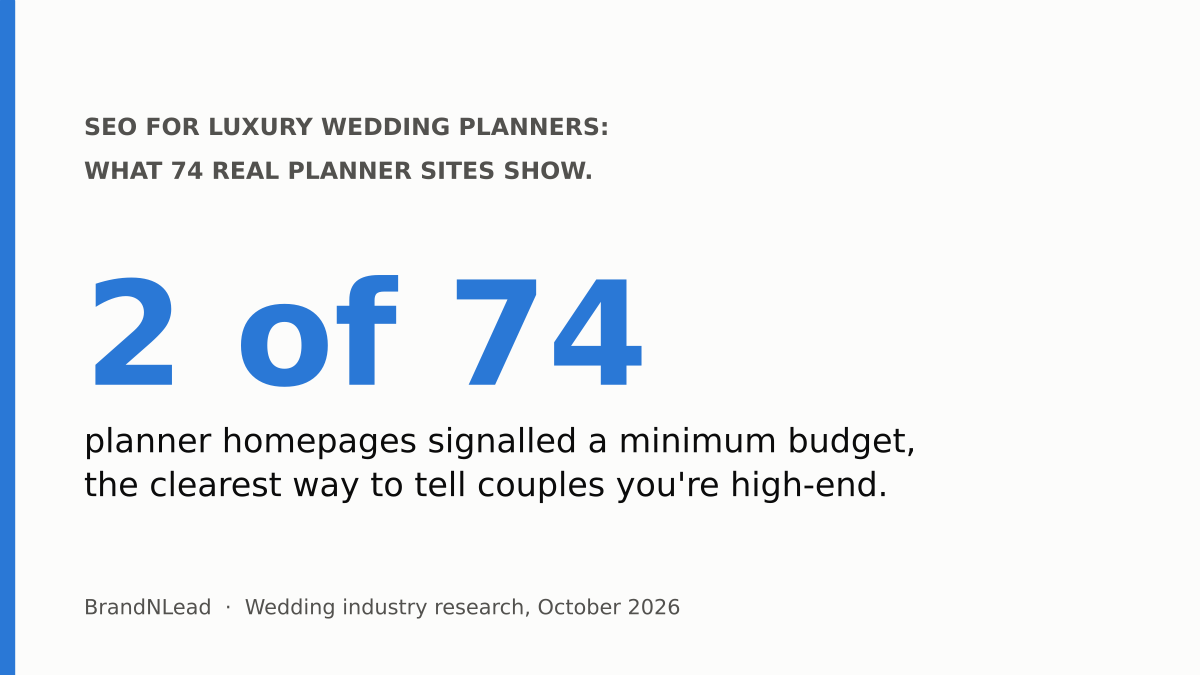
Most planner sites we checked don't do the last two. In our audit of 74 US and UK planner homepages, only 6 showed any price at all, and only 2 used the clearest luxury signal there is: a minimum budget. The median homepage took 9.7 seconds to show its main image on a phone, which no luxury brand would accept in a printed portfolio.
What do high-budget couples search for?
We don't have search volume data for luxury wedding terms, and anyone quoting exact numbers for searches this small should show their source. What we can say from how the searches are built:
- Location plus level: "luxury wedding planner Charleston", "high-end wedding planner London".
- Destination: "Lake Como wedding planner", "destination wedding planner Amalfi Coast", often searched from another country.
- Venue names: couples who've booked or shortlisted a venue search "[venue] wedding planner" or look for real weddings held there.
- Your name: most luxury work comes from referrals, and referred couples search your name before they reach out. That search lands on your site, your Google profile and your press.
- AI assistants: couples ask ChatGPT or Gemini for planner recommendations. In our test of 40 AI answers, every one named real planners, and 31 linked planners' own websites.
How do luxury planners show price without scaring the right couples off?
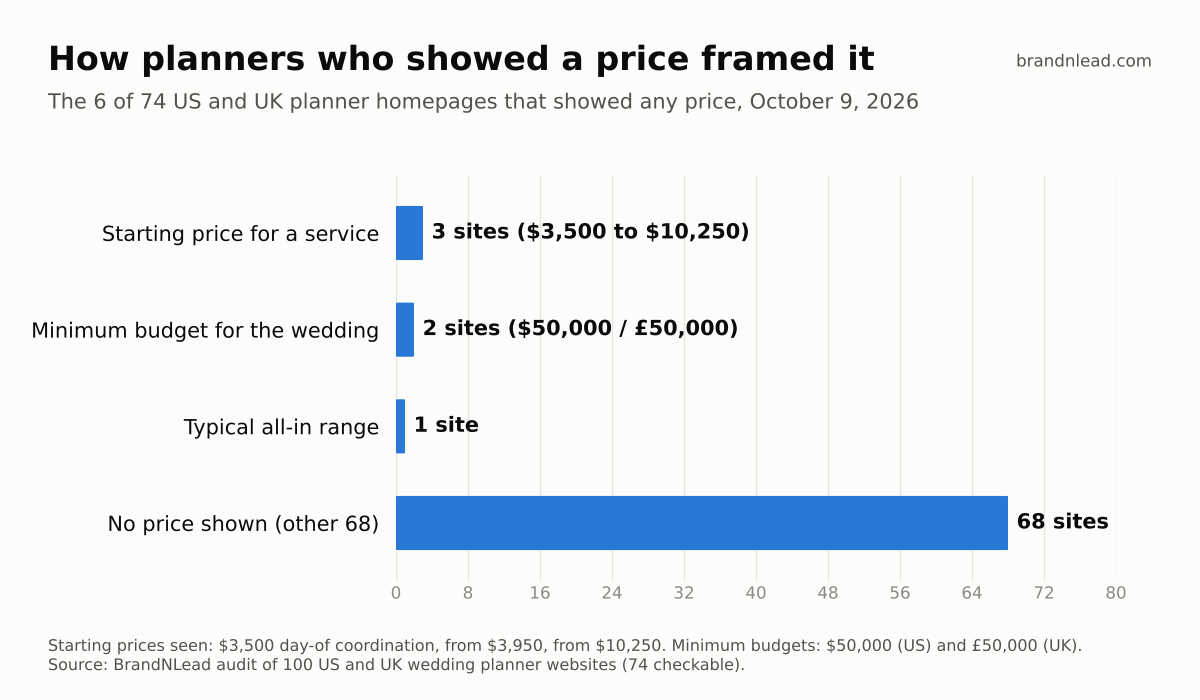
Of the 6 homepages that mentioned money, three gave a starting price for a service (from $3,500 for day-of coordination up to "rates begin at $10,250"). Two did something different: they stated a minimum wedding budget, one of $50,000 in the US and one of £50,000 in the UK. One gave a typical all-in range.
For a luxury planner, a minimum budget does two jobs at once. It tells the right couples they're in the right place, and it quietly removes couples who would never book you, before they take up a consultation. Our judgment: if your work starts at a level most couples can't reach, say so near the top of your services page, for example "Our full-planning couples typically invest from $[X] in their wedding; planning fees begin at $[Y]."
Which pages does a luxury planner website need?
Each page should match one kind of search. This is our recommended structure, not a measured result:
- One service page per location or destination you genuinely serve, each with real weddings planned there.
- Venue pages or real-wedding posts named after the venue, for the places you work most. Couples search venue names.
- An investment page with your minimum budget or starting fee and what's included.
- A press or "as seen in" page listing publications that featured your weddings, linking to each feature.
- An about page with you and your team, your years in business and the kinds of weddings you take on.
- A clear homepage first line, such as "Luxury wedding planner in Charleston and destination weddings in Europe". Our homepage copy guide has templates.
Which directories and publications matter at the top end?
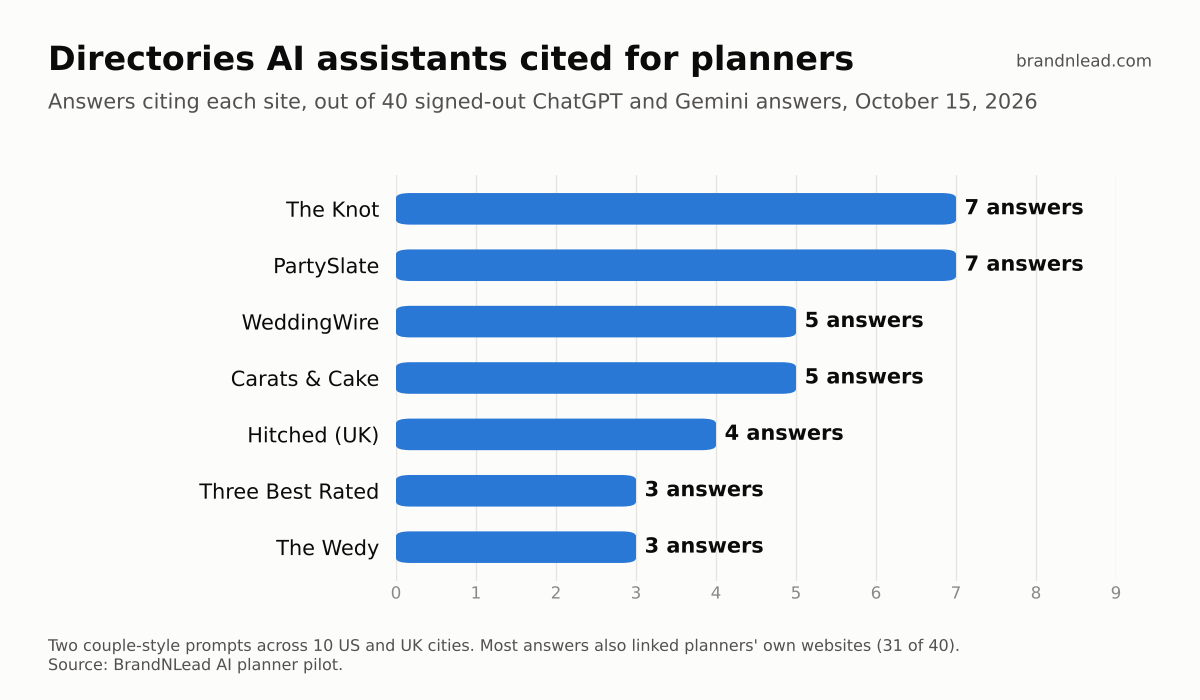
When we asked ChatGPT and Gemini to recommend planners in 10 US and UK cities, the directories they cited most were The Knot and PartySlate (7 answers each), then WeddingWire and Carats & Cake (5 each). In our view, PartySlate and Carats & Cake both lean toward high-end weddings, so for a luxury planner a strong, current profile on them is worth the time. Our AI recommendation test has the full results.
Publications work the same way. A feature in a respected wedding magazine or blog is proof for couples, a link that helps Google trust you, and a page AI assistants may read. Keep a list of every feature with its link, and link to each one from your press page.
Why does speed matter more for luxury sites?
Luxury sites lean on large, beautiful photography, which is exactly what slows a phone down. None of the 73 planner homepages we speed-tested showed its main image within Google's 2.5-second "good" line, and 70 took longer than 4 seconds. Resize photos to the size they're shown, write descriptive alt text, and use file names that describe the photo; Google's image guidance says alt text is the most important attribute it uses to understand an image.
Should a luxury planner do SEO at all, or rely on referrals?
Both. SEO for a luxury planner is often less about strangers finding you and more about making sure that when a referred couple, a venue or a fellow vendor searches your name, everything they find is consistent, current and clearly high-end. That means your website, your Google Business Profile, your directory profiles and your press all saying the same thing.
If you also want new couples from search, focus on a small number of specific pages (destinations, venues, real weddings) rather than chasing broad terms. Our SEO checklist covers the basics in order, and our Google Business Profile guide covers the local listing.
What does luxury wedding SEO cost, and how long does it take?
Published prices from wedding SEO providers range from one-off audits to monthly retainers; we list 22 of them, with what each includes, in our guide to what wedding SEO costs. Our own SEO for wedding planners is $2,000 for the first four months, then $299 a month.
Expect months, not weeks, and be wary of anyone who promises a position: Google's own guide to hiring an SEO says no one can guarantee a #1 ranking.
How did we collect this data?
- Website audit: 100 US (70) and UK (30) wedding planner websites found through Google searches; 74 homepages were live and checkable and 73 were speed-tested on October 9, 2026. Prices are quoted as they appeared on each homepage.
- AI test: 40 signed-out ChatGPT and Gemini answers to two couple-style questions across 10 US and UK cities, October 15, 2026.
- Limits: homepages only and small samples. We didn't separate luxury planners from others in the audit, and we didn't measure search volume or rankings. Individual sites are not named.