How do wedding venues rank on Google?
Through two systems at once. Google Maps and the local results box, which run on your free Google Business Profile, rank venues by relevance, distance and prominence. Regular search results rank your website pages. A venue that wins both has a complete, well-reviewed Business Profile and a fast website with a page for every question couples ask before they book a tour: capacity, price, dates, catering, photos and real weddings.
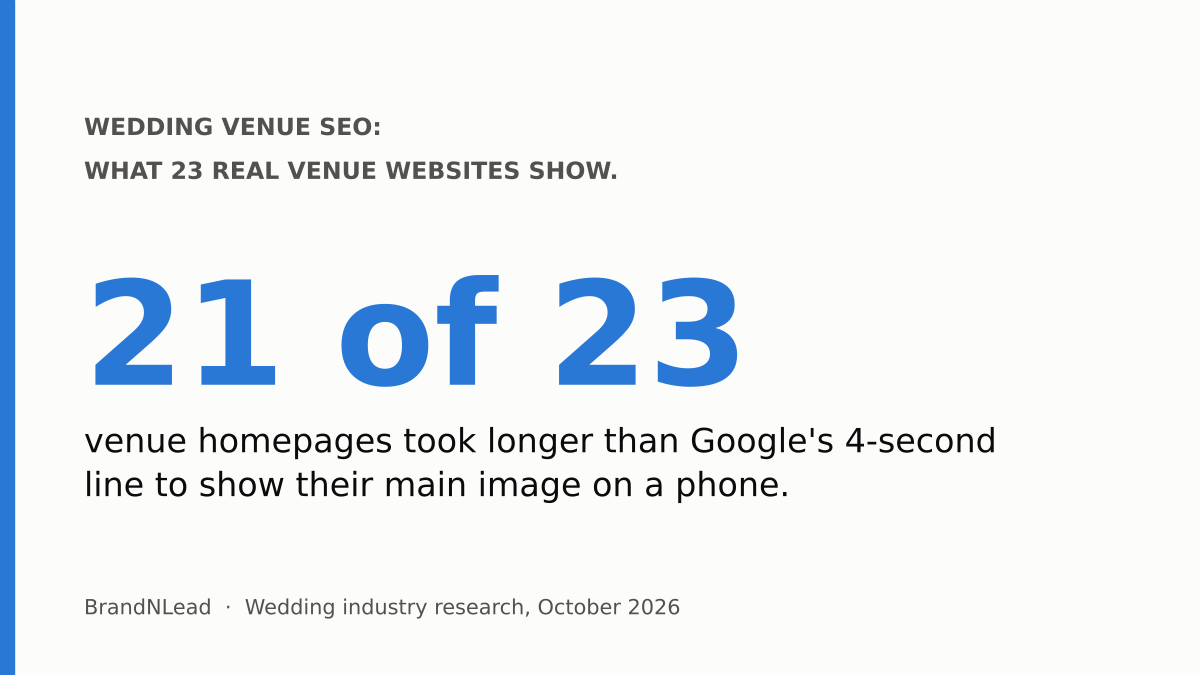
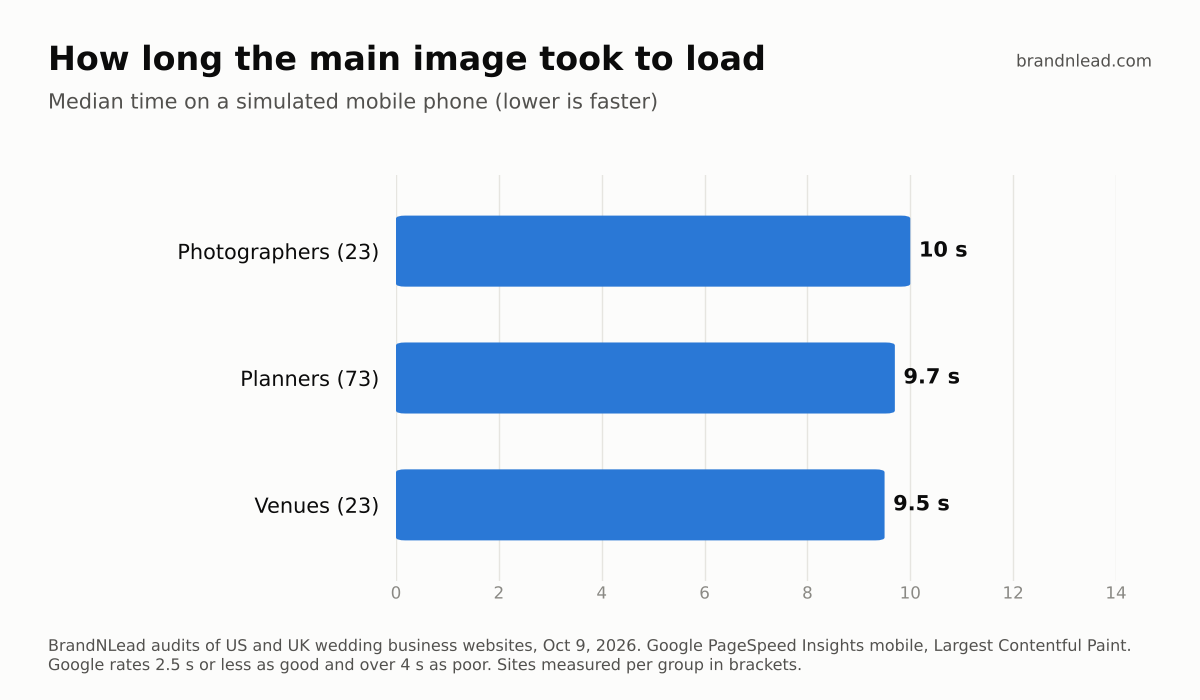
Most venue sites we tested have one clear weakness: speed. We checked 23 wedding venue homepages, mostly in US markets, on October 9, 2026. The median took 9.5 seconds to show its main image on a phone; 21 of 23 took longer than Google's 4-second "poor" line, and 11 took more than 10 seconds. Full results are in our venue and photographer speed test.
What did our test of 23 venue websites find?
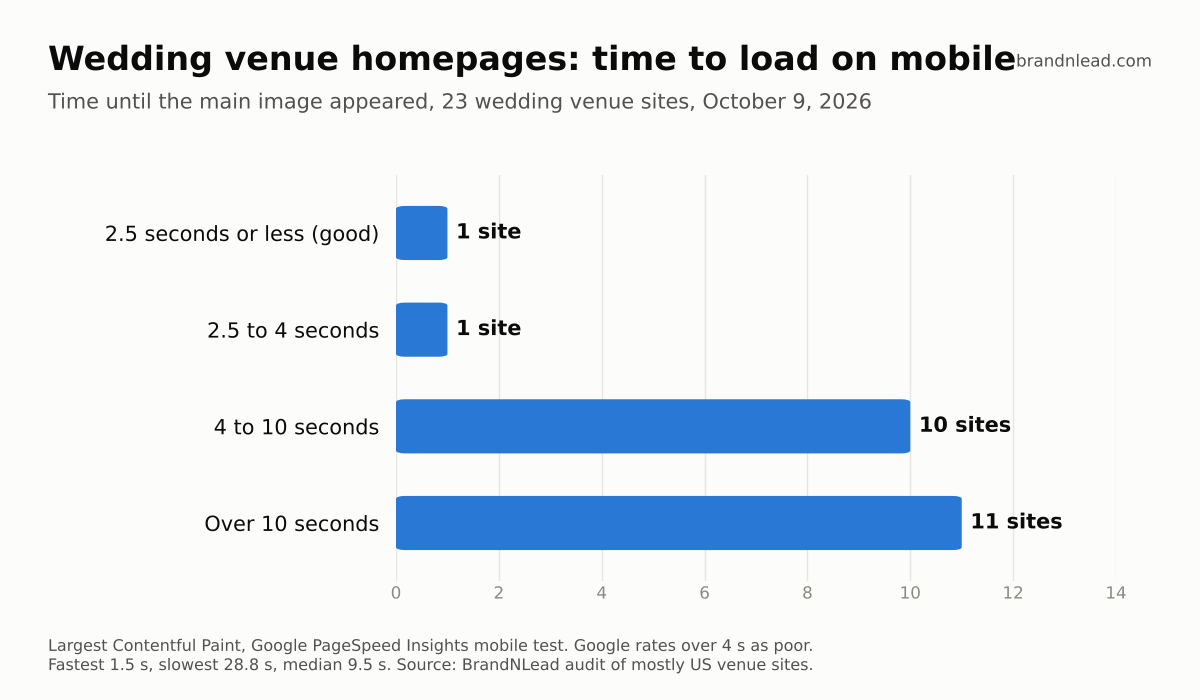
- Speed was the big problem. Median main-image load 9.5 seconds; the fastest 1.5 seconds and the slowest 28.8. We measured Largest Contentful Paint, the time until the biggest thing on screen loads (web.dev).
- The basics were mostly fine. 21 of 23 had a meta description, and the median Lighthouse SEO score (Google's automated check for search basics) was 92 out of 100, with 9 scoring a perfect 100.
- The overall performance score was low: a median of 51 out of 100 on mobile.
Which pages does a wedding venue website need?
Every question a couple asks on a tour is a search they make first. Give each its own page or clear section. This is our recommended structure, not a measured result:
- Spaces and capacity: each ceremony and reception space, with seated and standing capacity and photos.
- Pricing: a starting price or "from" figure by season and day of the week. Many couples rule venues in or out on budget before they look at anything else.
- Availability: how to check dates, and which seasons book first.
- Catering and vendors: in-house or outside catering, and your preferred vendor list.
- Real weddings: one post per wedding, with the season and style in the title, crediting the photographer and vendors.
- Getting there: location, parking, nearby hotels, and rain plans.
- FAQs: curfew, noise, outside alcohol, deposits, accessibility.
- Book a tour: a form or scheduler on the homepage and every key page.
How do you set up Google Business Profile for a venue?
Unlike most planners, a venue is a place couples visit, so show your address. Choose Wedding venue as your primary category, add real photos of every space, set accurate opening hours for tours, and keep your name exactly as it appears on your signage. Google says local results are ranked on relevance, distance and prominence, and that more reviews and positive ratings can help (Google Business Profile Help). Our Google Business Profile setup guide walks through each step.
Ask every couple for a review after their wedding. Google's policies ban reviews posted in exchange for an incentive and ban asking only happy customers (fake engagement policy), so ask everyone, with nothing offered in return.
How do you make venue photos work for search?
Venues sell with photos, and photos are what slow venue sites down. Two jobs: make them fast and make them findable. Google's image guidance says alt text is the most important attribute for telling it what an image shows, and recommends short, descriptive file names and placing images near relevant text (Google Search Central).
- Export each photo at the size it's shown, as JPEG or WebP, a few hundred kilobytes rather than several megabytes.
- Replace video banners and slideshows at the top with one strong photo.
- Name files and write alt text that describe the space: "barn-ceremony-space-sunset.jpg", "Outdoor ceremony lawn set for 150 guests at sunset".
- Show a few photos per space on each page and link to full galleries instead of loading them all at once.
Our photographer SEO guide goes deeper on image SEO, and our Squarespace test covers the platform many venue sites use.
Should a venue add structured data?
Yes. Structured data is code that tells search engines facts about your business in a standard format; Google recommends the JSON-LD format (Google Search Central). Schema.org, the shared vocabulary search engines use, has a specific EventVenue type. Include your name, address, phone, opening hours, photos and maximum capacity, and check it with Google's Rich Results Test.
How do directories and AI assistants fit in?
Couples also find venues through wedding directories and, increasingly, AI assistants. Keep every directory listing consistent with your website: the same name, capacity, pricing and photos. AI assistants read websites and directories when they recommend businesses, so clear, consistent facts in both places give them something accurate to say.
Should a venue make pages for nearby towns?
Only if each page is genuinely useful. Google's spam policies treat "doorway" pages, near-identical pages made only to rank for different place names, as spam. A page titled "Weddings near [town]" that just swaps the town name is risky and unhelpful.
A useful version answers what a couple from that town actually needs: drive time, the nearest hotels for their guests, real weddings you've hosted for couples from there, and how your pricing compares with venues closer to them. If you can't write that, don't make the page; put the towns you draw couples from on your getting-there page instead.
How do you know if SEO is booking tours?
Rankings are a means, not the goal. Track the path from search to tour:
- Google Search Console: verify your site and watch impressions and the searches you appear for each week. This is your early signal.
- Google Business Profile performance: see how many people called, asked for directions or clicked through to your site from Maps.
- Your analytics tool: count tour-form submissions as a goal (in Google Analytics 4 this is called a key event), so you can see which pages lead to tour requests.
- Ask on the form: add a required "How did you hear about us?" question with options such as Google search, Google Maps, Instagram, a directory, a referral and an AI assistant. It's the simplest way to connect bookings to channels. We added the same question to our own booking form.
Give it three to six months before judging, and judge the trend, not single weeks. Wedding search is seasonal, so compare each month with the same month last year once you have a year of data.
Venue SEO checklist
- Test your homepage at pagespeed.web.dev (mobile) and get the main image under 4 seconds.
- Claim your Google Business Profile with Wedding venue as the category and real photos.
- Publish a page for spaces and capacity, pricing, catering, availability and FAQs.
- Add a tour booking form to the homepage.
- Write one real-wedding post per event, crediting vendors.
- Add EventVenue or LocalBusiness structured data and test it.
- Ask every couple for a Google review.
- Keep directory listings identical to your website.
Wondering whether it's worth the effort? See is SEO worth it for wedding businesses. For help, we do SEO and website design for wedding businesses, venues included.
How did we collect this data?
- Sample: 25 wedding venue websites, mostly in US wedding markets, found through Google searches. 23 were measurable on October 9, 2026; one couldn't be speed-tested and one was behind a security check.
- Test: one Google PageSpeed Insights mobile run per homepage (Largest Contentful Paint, performance score, Lighthouse SEO score) plus a check for a meta description.
- Limits: homepages only, one test each, a small sample. We didn't measure rankings or tour bookings. Individual venues are not named.