How does SEO work for a wedding photographer?
SEO (search engine optimization) for a wedding photographer means making your website the answer when couples search for a photographer in your area, at the venues you shoot, and for the style you shoot. In practice that's four jobs: a fast site, pages and blog posts that match real searches, photos Google can understand, and a Google Business Profile. Most photographers we tested have room to improve on the first one.
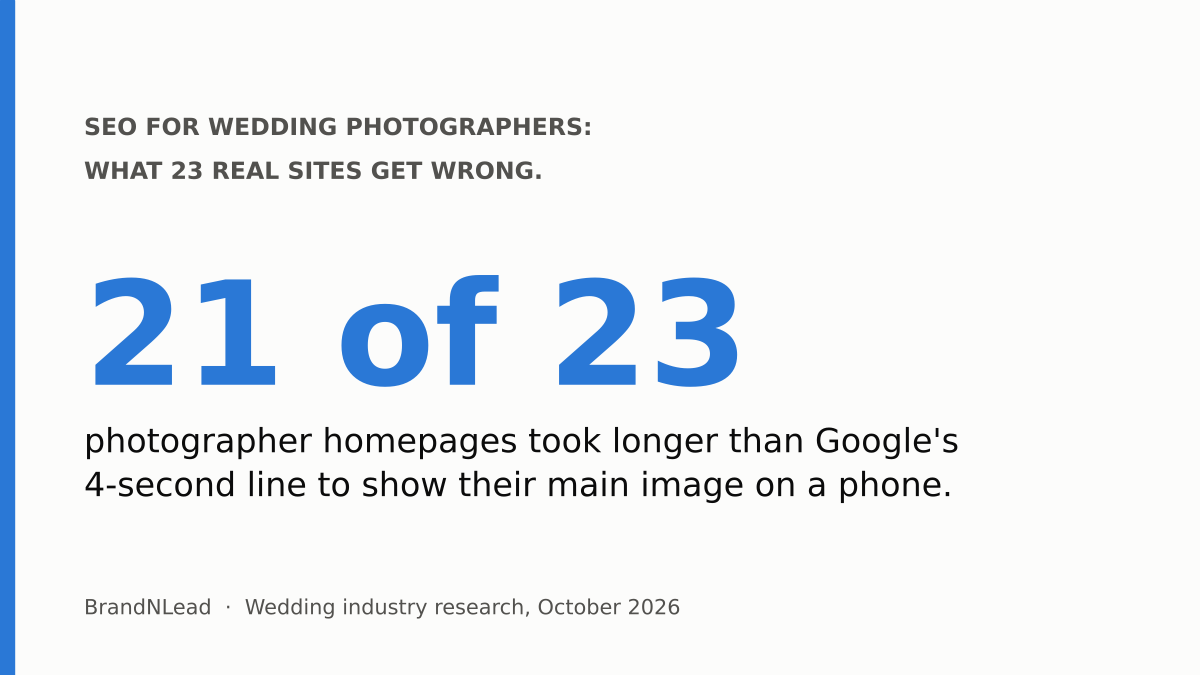
We tested 23 wedding photographer homepages, mostly in US wedding markets, on October 9, 2026. 21 of 23 took longer than Google's 4-second "poor" line to show their main image on a phone, 11 took more than 10 seconds, and 6 had no meta description. Below is what we found and the fixes we'd make, in order.
How fast are wedding photographer websites?
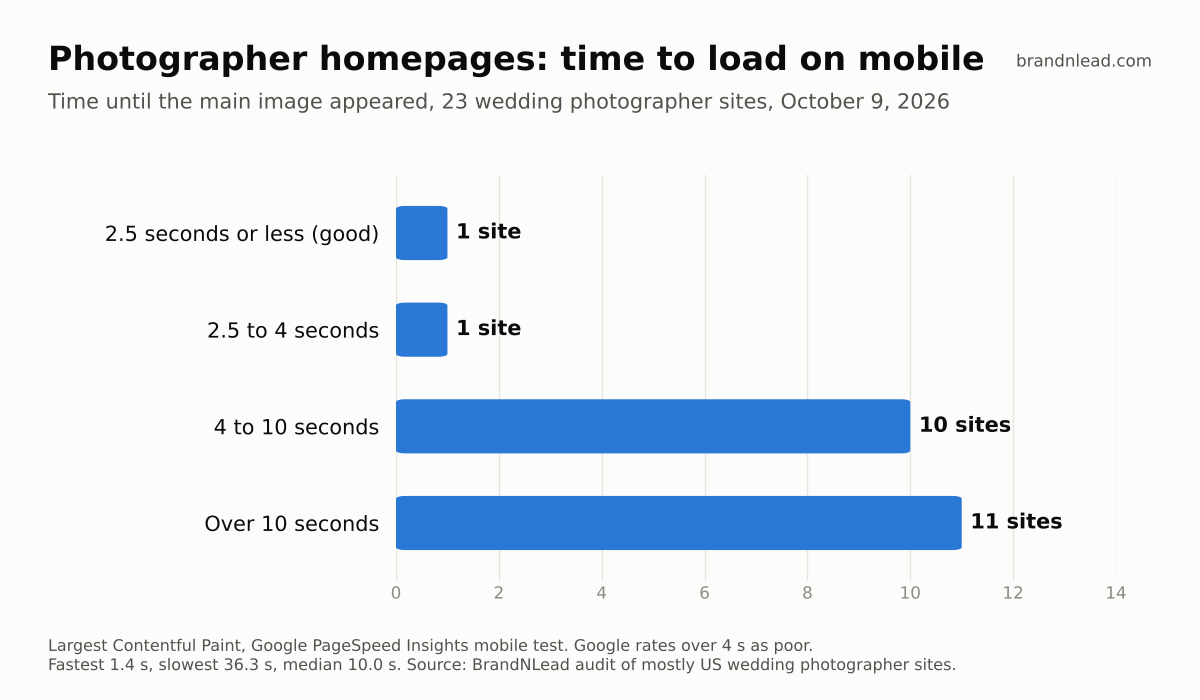
We measured Largest Contentful Paint (LCP), the time until the biggest thing on the screen, usually your hero photo, finishes loading. Google rates 2.5 seconds or less as good and over 4 seconds as poor (web.dev). The median photographer homepage took 10.0 seconds. Only 1 of 23 hit the good line. The fastest loaded in 1.4 seconds and the slowest in 36.3.
Photographers sell with photos, so big images are unavoidable, but they don't have to be full-size files. We compared photographers with venues and planners in our speed test of 46 venue and photographer sites.
What else did photographer websites get wrong?
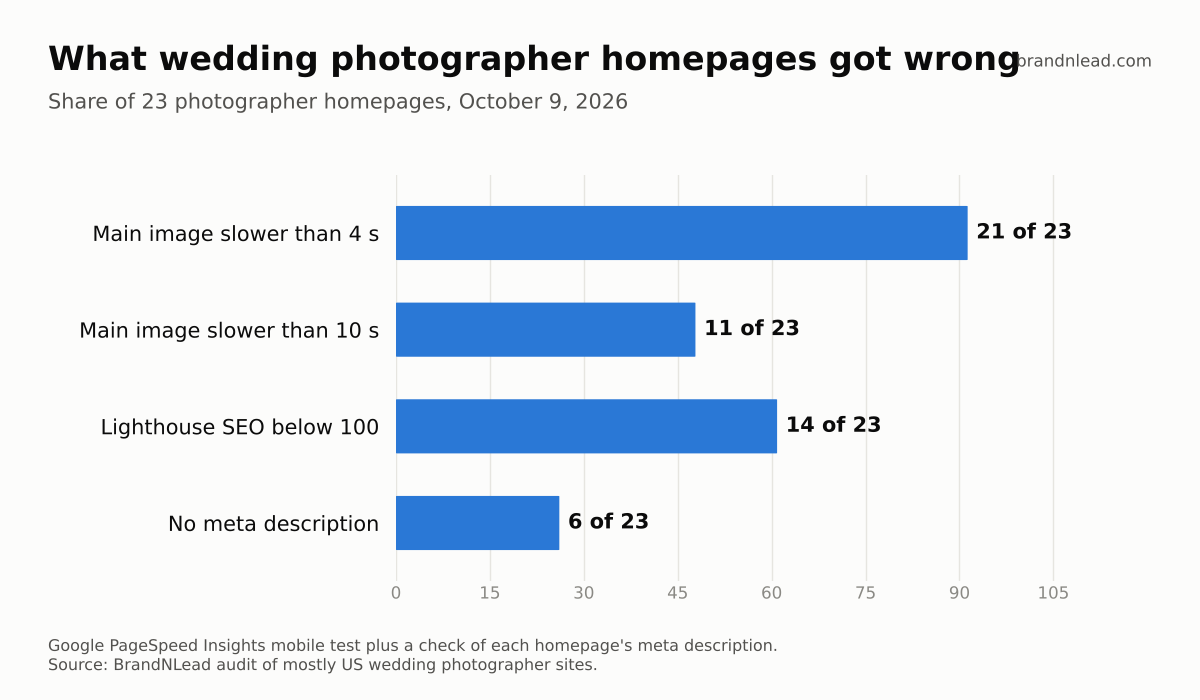
- No meta description on 6 of 23. A meta description is the one- or two-sentence summary you write for each page. Google sometimes shows it under your link; without one, Google picks text from the page.
- Lighthouse SEO below 100 on 14 of 23. Lighthouse is Google's automated check for search basics like meta descriptions, link text and crawlability. The median was 92, so most issues were small, but they're also the easiest to fix.
- Median PageSpeed performance score of 61 out of 100, higher than the planners (55) and venues (51) we tested, but still well short of good.
What should a wedding photographer's website target in Google?
Give every kind of search its own page, rather than hoping the homepage ranks for everything. This is our recommended structure, not something we measured:
- Homepage: your main location and specialty, such as "Wedding photographer in Asheville, North Carolina", in the page title, the main heading and the first sentence.
- Pricing or investment page: couples search for prices. Even a starting price helps them self-qualify before they inquire.
- One blog post per real wedding: put the venue name in the title, such as "A summer wedding at [venue name]". Couples researching a venue often search its name, and few photographers write a proper post about each one.
- Venue guides: if you shoot somewhere often, write a guide to photographing there: best spots, light at different times, rain plans. That's useful to couples and planners, and it's hard to copy.
- About page: who you are and where you work. Couples hire a person.
How do you make wedding photos show up in Google?
Google can't see a photo the way a couple does, so it reads the text around it. Google's own image guidance says alt text is the most important piece of image information, recommends short but descriptive file names, and says images should sit near relevant text on a relevant page (Google Search Central). For a photographer, that means:
- Rename files before uploading. Use something like "bride-groom-first-look-biltmore-estate.jpg", not "IMG_4821.jpg".
- Write alt text that describes the photo, such as "Bride and groom's first look on the terrace at the Biltmore Estate". Describe what's in the image; don't stuff it with keywords.
- Put a few sentences of real text next to each gallery: the venue, the season, what made the day memorable.
- Export at the size it's shown. Around 2,000 pixels wide is plenty for most full-width layouts, saved as JPEG or WebP at a few hundred kilobytes rather than several megabytes.
Do wedding photographers need a Google Business Profile?
Yes, if you want to show up when couples search "wedding photographer near me". It's free, and it's the listing that appears in Google Maps. Choose Wedding photographer as your category, hide your address if clients don't visit you there, keep your service area realistic and ask every couple for a review after delivering their gallery. Our 60-minute Google Business Profile setup walks through each step and Google's rules.
How do you get other websites to link to you?
Links from other relevant sites still help Google trust you. For a photographer, the honest ways to earn them are built into the job:
- Vendor credits: when you share a wedding, credit and link the planner, venue and florist, and ask them to do the same on their posts.
- Venue preferred-vendor lists: ask the venues you shoot at most whether they list photographers.
- Published weddings: submit your best weddings to wedding blogs and magazines that credit vendors with a link.
- Never buy links. Paying for links that aren't labeled as sponsored breaks Google's spam policies, and it can hurt your site.
How much does SEO cost for a wedding photographer?
You can do the steps above yourself for free; what you pay for is time. If you'd rather hire help, many wedding SEO specialists come from the photography world, and their prices range from one-off audits to monthly retainers. We collected 22 published prices from US and UK providers in our guide to what wedding SEO costs. Whatever you choose, be wary of anyone who guarantees rankings: Google says no one can.
We also do this work for wedding businesses, photographers included; see our SEO for wedding businesses. If your site is on Showit, our Showit SEO test covers that platform's specific gaps.
How did we collect this data?
- Sample: 25 wedding photographer websites, mostly in US wedding markets, found through Google searches. 23 were measurable on October 9, 2026; two were left out because the test couldn't reach one and the other's hosting account was suspended.
- Test: one Google PageSpeed Insights mobile run per homepage, recording Largest Contentful Paint, performance score and Lighthouse SEO score, plus a check for a meta description.
- Limits: homepages only, one test each, a small sample. We didn't measure rankings, check galleries or blog posts, or record which platform each site used. Individual sites are not named.