How can wedding planners use AI?
Use AI for first drafts and admin: inquiry replies, timelines, proposals, meeting notes and marketing. Don't trust it with facts, prices or anything you'll sign without checking. That's not theory. We use AI assistants every day to research the wedding industry, and in October 2026 one of them told us that none of the planner websites in our audit had a meta description. When we opened the sites ourselves, 59 of 73 did.
Your couples are already using it. The Knot's 2026 Real Weddings Study found about 36% of engaged couples were using AI to plan their wedding by the end of 2025. And when we asked ChatGPT and Gemini to recommend planners in 10 cities, all 40 answers named specific businesses. Here's how to use it well, which planner tools have it built in, and where it goes wrong.
What do couples already use AI for?
The tasks couples hand to AI are the same ones planners do. In an Add to Event survey of UK newlyweds, reported in December 2025, 32% had used AI to help plan their wedding:
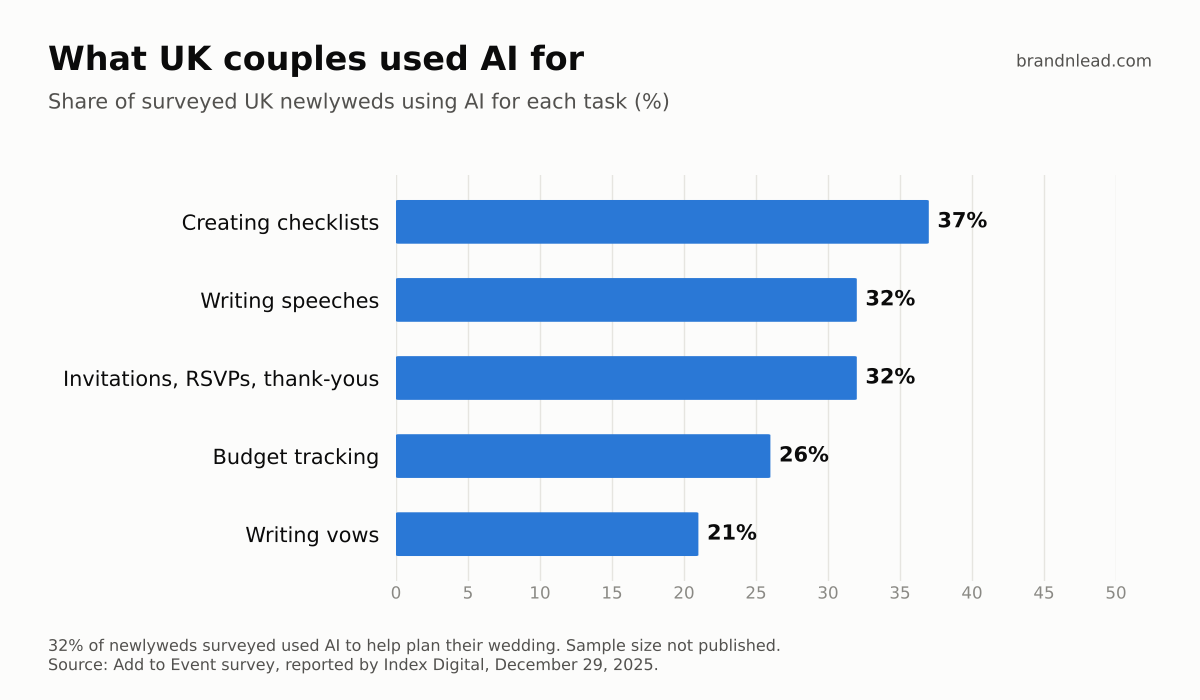
If a couple can get a decent checklist from ChatGPT, your value is everything around it: judgement, vendor relationships, and being the calm person on the day. Use AI to get the paperwork out of the way so you have more time for that.
Which five jobs does AI do well for wedding planners?
1. Replying to inquiries fast
Speed wins bookings. In The Knot's 2026 study, 52% of couples choosing a planner named responsiveness as a top deciding factor. A good prompt turns an inquiry into a draft reply in seconds; you check it and send. Copy this one and fill in the brackets:
You are my assistant at [business name], a wedding planner in [city].
Draft a reply to the inquiry below in a warm, direct tone.
- Thank them and repeat back their date and guest count.
- Say whether [date] is open.
- Give my starting price: [price].
- Offer two call times: [time 1] or [time 2].
Keep it under 150 words. Don't promise anything I haven't listed.

Inquiry: [paste the inquiry, with surnames and phone numbers removed]
2. Building timelines and run sheets
AI is good at turning fixed points into a block-by-block schedule. It is not good at knowing your venue's rules, your photographer's habits or how long your florist really needs, so treat its timeline as a draft to correct:
Build a wedding-day timeline for a [ceremony time] ceremony at [venue type] with [guest count] guests.
Fixed points: [first look yes/no], [sunset time], [toasts], [first dance], [venue end time].
Use 15-minute blocks. For each block, name who is responsible.
Flag any block with less than 15 minutes of buffer, and list your assumptions at the end.
3. Drafting proposals and client questionnaires
Proposals, welcome emails and questionnaires follow patterns, so AI can produce a solid first version. Our free client questionnaire started as an AI draft, which we then edited by hand, question by question.
4. Taking meeting notes and follow-ups
Planner software now does this inside the tool you already use. HoneyBook offers AI meeting notes and Dubsado lists an AI call recorder (details below), so a consultation can end with a summary and a to-do list instead of a page of scribbles.
5. Turning real weddings into marketing
Wedding educator Candice Coppola suggests recording voice notes and having ChatGPT turn them into blog drafts (Candice Coppola, September 2025). The same idea works for captions. The key line in this prompt is the last one, because AI fills gaps with invented details if you let it:
Turn these notes from a real wedding into:
1. A 120-word Instagram caption
2. A blog post outline with 5 question-style headings
Notes: [paste your notes, venue and vendor names]
Write in my voice: [three words that describe how you talk].
Only use details from my notes. If something is missing, ask me instead of inventing it.
Which wedding planner tools have AI built in?
We read each company's own pages on October 16, 2026:
- HoneyBook lists AI meeting notes, daily task plans, predictive lead alerts, AI email drafts, project summaries, AI chat, lead enrichment and follow-up suggestions (HoneyBook AI). It also claims AI users get a “30% higher booking rate” and “20 hours back every week”, with no source or method given, so treat those as marketing.
- Dubsado lists three AI-powered features: a form builder and generator, a call recorder and email summaries, covered by its AI Features Addendum (Dubsado, updated May 28, 2026).
- Aisle Planner's homepage didn't mention AI features when we checked.
Pricing and plan details for all three are in our HoneyBook vs Dubsado vs Aisle Planner comparison.
Where does AI go wrong?
Confidently, and in ways that look right. These examples come from our own research for this blog, before we checked the work by hand:
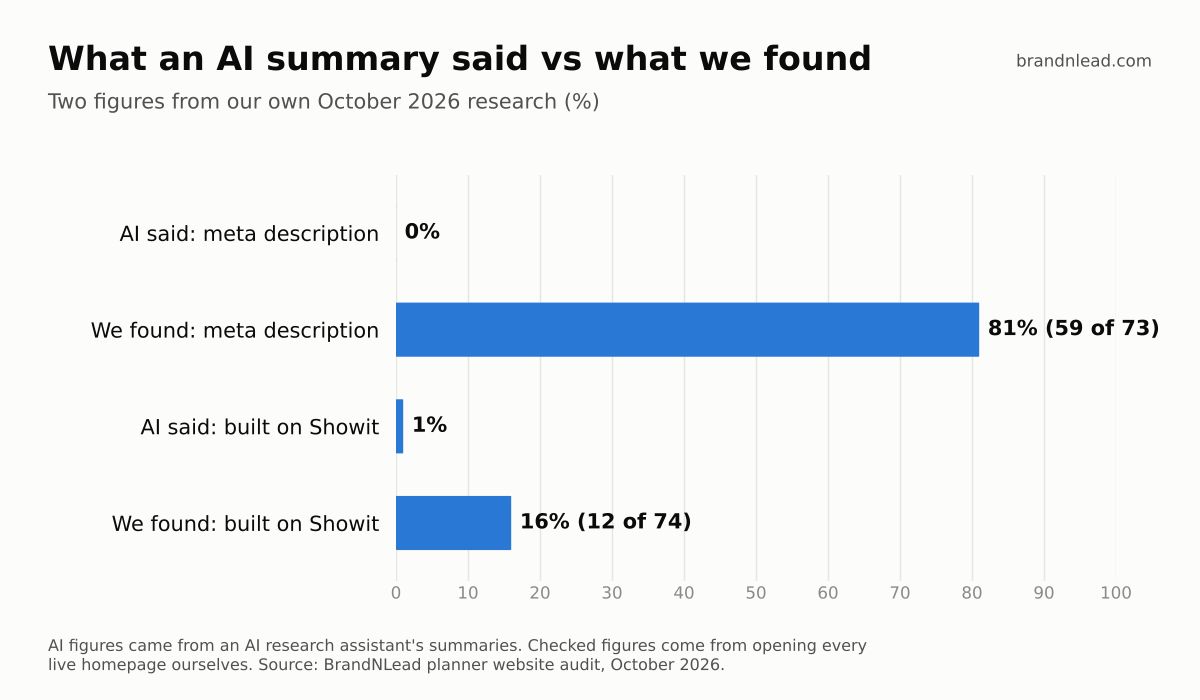
- Meta descriptions: an AI-run audit summary said 0% of the planner sites had one. We opened every live homepage and found them on 59 of 73. The full results are in our audit of 100 planner websites.
- Platforms: a second AI run put Showit at 1% of planner websites. Our verified audit found Showit on 12 of 74 live homepages.
- Wording: when we had AI summarize 25 planner homepages, a second check corrected 9 of its descriptions, such as calling a text link a button.
None of these were lies. Each was a tool reading pages badly and summarizing with confidence. The rules we now follow, and suggest you do too:
- Check every number against its source before it reaches a client or your website.
- Keep private details out. Remove surnames, phone numbers and addresses from anything you paste into a chatbot unless you've checked the tool's data settings.
- Never let AI write the binding parts. Contracts, deposits and cancellation terms need you, and ideally a lawyer.
- Ask it to list its assumptions, as the timeline prompt above does, so you can see what it guessed.
Will AI recommend your planning business?
It already recommends planners. In our October 15, 2026 test, all 40 ChatGPT and Gemini answers named specific businesses, and in the US answers the sources they cited most were planners' own websites, The Knot, PartySlate and WeddingWire. Our guide to getting recommended by ChatGPT and our look at where couples find planners cover what that means for you.
To see what ChatGPT and Gemini say about your business today, request our free AI Visibility Snapshot.
How we checked this
- Software features: HoneyBook's AI page, Dubsado's AI features page and Aisle Planner's homepage, read on October 16, 2026.
- Couple data: The Knot 2026 Real Weddings Study read-out and the Add to Event survey as reported by Index Digital (no sample size published).
- Our AI errors: from our own October 2026 research files. Checked figures come from opening each site in a browser.