Is The Knot worth it for wedding vendors?
It can be, but only if one or two extra bookings a year cover the cost and you track every lead to prove it. The Knot doesn't publish its advertising prices, so you can't judge it from the outside. Here's what we could verify on October 16, 2026: what it costs according to the people who've looked, how The Knot and WeddingWire relate, what the reported Zola deal changes, and which directories ChatGPT and Gemini actually cite when a couple asks for a planner.
That last part is our own data. On October 15, 2026, we asked ChatGPT and Gemini, signed out, for wedding planners in six US cities. The Knot was cited in 8 of 24 answers, more than any other wedding directory. Zola was cited once.
How much does The Knot cost for vendors?
The Knot doesn't say. Its advertising page lists audience numbers but no prices. WeddingPro, the company that sells The Knot and WeddingWire advertising, says only that it “offers several flexible plans to meet vendors' varying budgets” (WeddingPro, May 29, 2026).
The figures you'll find online are estimates, and none of them cite a rate card:
- $125 to $150 a month to start, rising past $1,000 a month in competitive markets, with featured listings at $5,000 to $15,000 a year, according to Evolve Your Wedding Business (updated March 10, 2026). The author says the numbers are “from what I've been able to gather”.
- $1,500 to $8,000+ a year for a premium directory listing, according to Style Me Pretty (February 25, 2026), with no source given.
Contract length matters as much as price. The same Evolve guide says “you will likely have to commit to a 12-month contract”. A vendor review of WeddingWire on Trustpilot, dated January 16, 2026, says: “Once you are locked into a 12-month contract, you cannot avoid the monthly advertising fee.” WeddingWire's TrustScore there was 1.5 out of 5 when we checked. Review sites attract unhappy customers, so treat that as a reason to read the terms, not as proof the ads don't work.
What to do: get the quote, the contract length and the renewal terms in writing before you agree to anything.
Are The Knot and WeddingWire the same company?
Yes. XO Group, which ran The Knot, merged with WeddingWire in December 2018, and the combined company has been called The Knot Worldwide since March 2019. Advertising on both sites is sold through WeddingPro. WeddingPro says it delivered over 9 million leads in a year to vendors advertising on The Knot and WeddingWire, from nearly 29,000 advertisers, and that the platform delivers 25,000 leads a day on average.
The Knot's own page claims “15+ million unique monthly visitors” and says “nearly 2.4 million couples sign up every year”. Those are the company's figures; we can't check them.
So buying both is not buying two independent channels. Before you add the second site, ask your sales rep whether one couple's inquiry can reach you through both, and how leads are counted if it does.
What does the Zola deal change for vendors?
On October 14, 2026, Reuters reported that The Knot Worldwide has agreed to buy Zola, citing two people familiar with the deal. The companies declined to comment to Reuters. The deal is subject to regulatory clearances, and according to Reuters' sources, Zola will keep running as a standalone brand.
That matters because Zola has been the main alternative. Zola's own guide says it is “Free to list for vendors” and describes The Knot as a “Paid advertising model with tiered options for vendors, meaning placement is often determined by payment” (Zola, updated April 17, 2026).
Until the deal closes, three sensible moves:
- Don't sign a new 12-month contract assuming Zola stays an independent, cheaper option. It may, but nobody outside the deal knows yet.
- Screenshot your Zola reviews now, and ask each couple before you reuse their words on your own website.
- Tag every inquiry by source for the next 90 days, so you know what each directory is worth to you when terms change.
Which wedding directories do AI assistants actually cite?
Couples have started asking ChatGPT and Gemini for planners, so we tested it. On October 15, 2026, we ran two prompts, “Who are the best wedding planners in [city]?” and “I'm getting married in [city] and need a full-service wedding planner. Who would you recommend?”, in ChatGPT and Gemini, signed out, for New York, Los Angeles, Chicago, Charleston, Austin and Miami. That's 24 US answers. Each answer counts once for each directory it cited as a source.
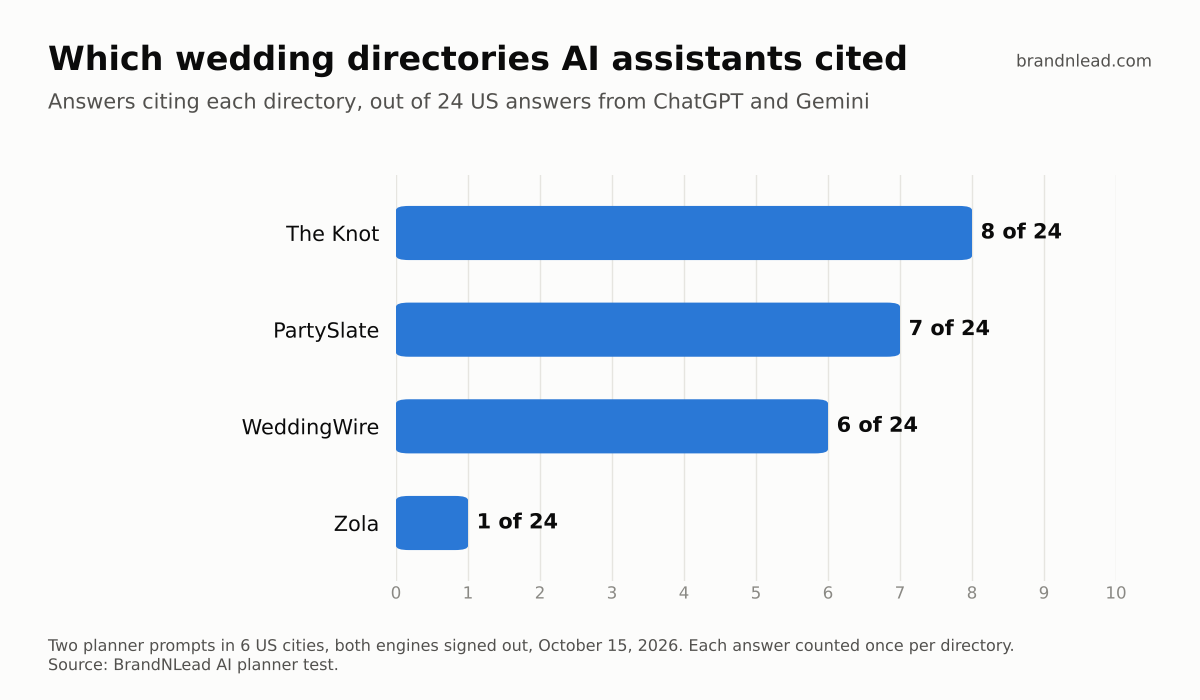
The Knot was cited in 8 of 24 answers, PartySlate in 7, WeddingWire in 6 and Zola in 1. The Knot's advertising page claims The Knot and WeddingWire “are #1 and #2 in visibility across leading AI platforms”. Our small test fits that for The Knot, but PartySlate, which The Knot Worldwide doesn't own, came a close second.
The two engines behaved differently. Gemini produced most of the directory citations: The Knot appeared in 6 of its 12 US answers and PartySlate in 7. ChatGPT cited planners' own websites in 8 of its 12 US answers. In our UK runs, Hitched was the directory that showed up, in 5 of 16 answers.
So a complete directory profile can help you get named by AI, and so can your own website. Our guide to getting recommended by ChatGPT covers the rest of this test. One caution: 24 answers on one day is a small sample, and AI answers change from run to run.
How do you work out if The Knot is worth it for your business?
Divide what a year of advertising costs by what one booking is worth to you. The result is how many bookings the ads must bring in just to pay for themselves, before you count your time.
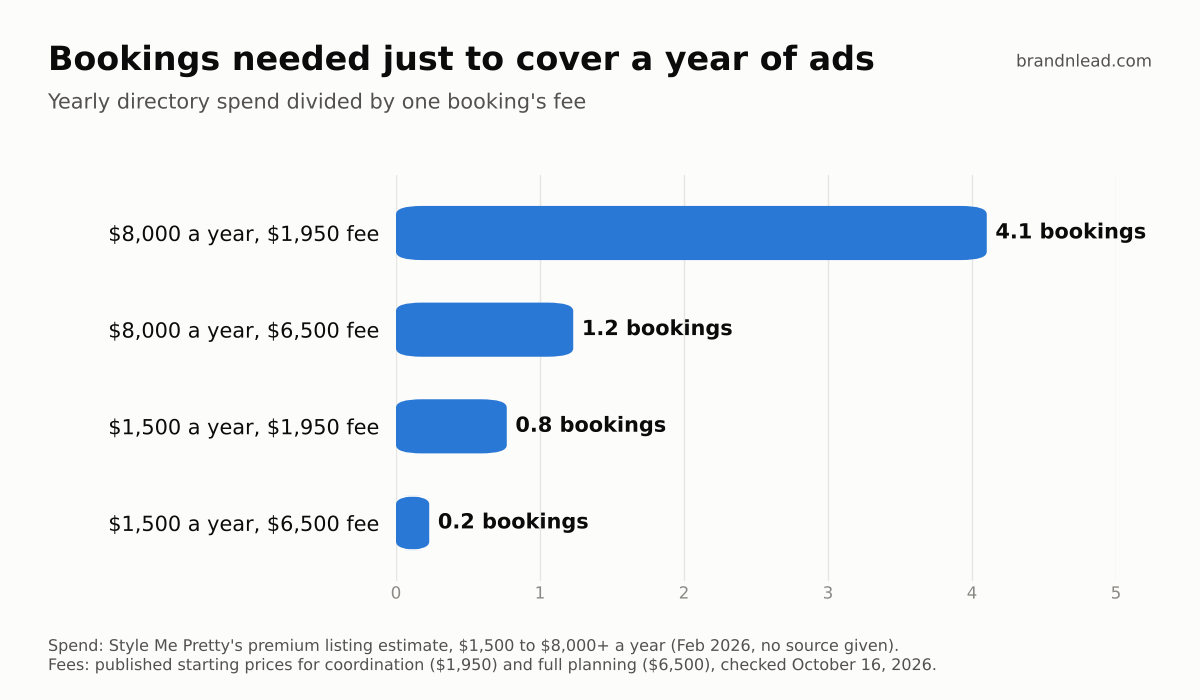
We used the Style Me Pretty estimate and two real starting prices from our free pricing guide: $1,950 for coordination and $6,500 for full planning. At $1,500 a year, one booking covers it either way. At $8,000 a year, a planner charging $1,950 needs just over 4 bookings from the directory, and one charging $6,500 needs 2.
Then judge the leads, not just the count. Before you sign, ask the rep:
- How many couples contacted vendors in my category and area last year?
- How long is the contract, and does it renew automatically?
- If I advertise on both The Knot and WeddingWire, are the leads separate?
- What happens if I want to leave early?
Once you're live, ask every couple how they found you. We added a “How did you hear about us?” question to our own booking form so every call has a source.
What should you do instead of, or as well as, a directory?
A directory rents you visibility. Your own website and Google Business Profile are the parts you keep if the terms change.
- Make your website fast and clear. In our audit of 100 planner websites, the median homepage took 9.7 seconds to show its main content on a phone.
- Show a starting price. Only 6 of the 74 live planner homepages we checked showed one, so a clear number sets you apart before a couple ever fills in a directory form.
- Claim and complete your Google Business Profile. In our test, some Gemini answers were map-based, and those draw on business profiles rather than directories.
- Check how AI describes you. Our free AI Visibility Snapshot shows which sources ChatGPT and Gemini pull you from.
If you'd rather couples found you on Google than pay per lead, that's the job of SEO for wedding planners.
How we checked this
- Prices and terms: on October 16, 2026, we read The Knot's advertising page, WeddingPro's advertiser guide, Zola's vendor guide, the two estimate articles and WeddingWire's Trustpilot page. The Knot, WeddingWire and Zola don't publish vendor advertising prices.
- AI test: 40 signed-out answers on October 15, 2026, from ChatGPT (20) and Gemini (20), across 6 US and 4 UK cities. Perplexity required a login, so it wasn't tested. The US figures use the 24 US answers, and each answer counts once per directory.
- News: the Zola deal is based on Reuters' report of October 14, 2026. Check its status before you sign anything long-term.